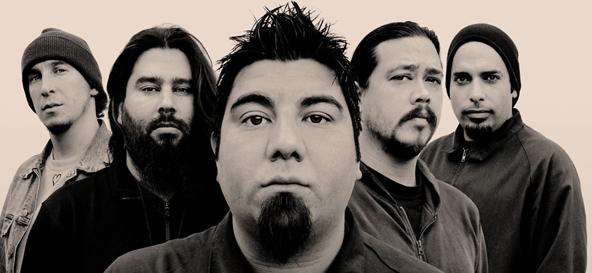
It’s the afternoon of March 23rd, six days after the onset of the second Gulf War, and roughly two hours before the start of the 75th Academy Awards. The taxi driver delivering us to the Deftones’ West Hollywood hotel has taken a wrong turn, striking Sunset Boulevard several blocks east of where he intended to, and the scene that greets is both remarkable and surreal. In previous years, throngs of tourists have filled this street’s sidewalks, hoping to glimpse the great and the good of the movie world. Today, the banks of bleachers brought in for them to sit on have been replaced by yards of yellow Police tape. On the other side of the road, banners bearing legends including ‘Impeach Bush!’ and ‘Give Peace A Chance’ hang from hastily erected crush barriers.
Later this evening, Michael Moore will hit the headlines (and, if rumour is to be believed, a stagehand) on account of his outspoken Oscar acceptance speech criticising his President’s participation in an illegal and immoral war. Here and now, on Tinseltown’s traditionally trouble-free thoroughfares, it’s already turning nasty. As we reach the intersection with Highland Avenue, the main route north into Hollywood, the atmosphere is appreciatively tense. Partygoers turned out in trim tuxedos and beautiful ball gowns are clashing with scruffy students brandishing boards bearing the name of George W Bush, but with the ‘s’ replaced by a swastika, and the fleets of sedans and stretched limos ferrying the famous towards the Kodak Theatre, where the ceremony will take place, are jeered. One man waves a placard proclaiming ‘The Oscars Are Weapons Of Mass DistrAction’.
The next morning, Los Angeles’ newspapers will earnestly debate the relationship between art and war. In deference to the conflict in Iraq, this year’s Academy Awards were intended to be a restrained occasion, but Hollywood – and especially the organisers of its grandstand gathering – doesn’t know how to do subdued any more than it knows how to do arthouse. As host Steve Martin quipped while surveying the sumptuous stage set, complete with 10 foot high revolving globe, ‘Well, I’m glad they cut down on the glitz…’ Perhaps the most perceptive comment comes from the unlikeliest of sources, however. While accepting her Oscar for Best Actress, Nicole Kidman posed the question, “Why do we come to the Academy Awards when the world is in such turmoil?” before answering it herself: “because art is important.”
Some hours later, the Deftones’ drummer Abe Cunnigham considers a superficially similar scenario. He’s holed up in Hollywood promoting a new album while on the other side of the world two of his countrymen are being paraded on Iraqi TV as prisoners of war.
“I couldn’t really give a shit about the Oscars. I’m very excited about or new record. And the war? It sucks. It’s fucking crazy man – but there’s not much I can do about it.”
His conclusion may lack the eloquence of Kidman’s, but he’s still got a point.
We join the Deftones at the very end of a five-day press junket. All bar one of the quintet live in Sacramento, an unremarkable city situated in northern California, but for the past week they’ve relocated to Los Angeles’ sumptuous Sunset Marquis hotel, playing host to the world’ rock press. Most of the members are married, some of them have children, and all of them want to go home (and, indeed, one – bassist Chi Cheng – already has). Ironically, it’s the one member of the band who actually lives in LA, guitarist Stephen Carpenter, who is the last to arrive for today’s activities, pulling up outside the hotel in his two-week old, sparkling silver BMW 745I a good hour and a half after the first photoshoot was scheduled to start. “Oh well,” says the representative from the record label resignedly, “we’re on Deftones time now.”
In terms of timekeeping and choice of car, then, the Deftones are very much the successful rock band. Put them in a recording studio, however, and the similarities end there and then. The band first found fame in the nebulous nu-metal movement of the mid- to late-‘90s, yet, aside from a fondness for facial hair and low-slung slacks, always worn at half-mast, they had little in common with their peers. From the outset, the Deftones went out of their way to distance themselves from the clutch of Korns, Kilgores and Coal Chambers that cluttered the scene; both directly in interviews, and more subtly on record. Their debut album, <<Adrenaline>>, was a bristling burst of het-up hardcore; it’s successor, Around The Fur, spread that sound out, incorporating melody and toying with textures; 2000’s White Pony proved the watershed, though, an exhilarating experiment in form and structure that combined intensity with invention, and which won the Deftones a Grammy (for their performance on the track ‘Elite’). The forthcoming fourth full-length, self-titled and slated for a summer release, is something else again though; a mesmerising melange of moods and sounds, Deftones quite genuinely sounds like nothing that has gone before. It bears as much relation to nu-metal as OK Computer did to Britpop.
“To me, Radiohead are a band that has always challenged themselves with every record they’ve made,” considers frontman Chino Moreno when I draw the comparison, “and I think that’s the main thing we try to do. Every time a new Radiohead record comes out, more people want to hear it because they want to know what’s gonna happen on it. That’s what keeps me a fan of that band, and hopefully us doing the same thing will have the same result for us. The bands that I like are always the ones that seem to push themselves in different directions, like the Beastie Boys, for instance. They started out writing these real simple, goofy hip-hop songs. But – what are they, like five albums from then, now? If their new records still sounded like that then I probably would have stopped buying them a long time ago. No matter what their influences at the time, they bring out new music and it’s still them. I dig that.”
In England’s Dreaming, an exhaustive analysis of the birth of punk rock, author Jon Savage argues that all pop movements start with an elite, but a point is always reached where that elite loses control, when the mass market and mass media take over. This is, he continues, “a necessary process if that movement is to become pop. Within this transaction, simplicity is inevitably imposed on complex phenomena, but there is also a fresh burst of energy released with unpredictable, liberating results.” It’s easy to apply the model to nu-metal; Kurt Cobain’s corpse was still warm when Korn released their epochal eponymous debut album in 1994. The new wave of extreme music that it ushered in picked off the grunge stragglers as surely as Nevermind had hair metal bands before it. Yet as the platinum discs mounted up, the initially innovative nu-metal movement was quickly assimilated into mainstream culture. Within five years the music had become so stagnated, so creatively bankrupt, that even its leading lights were releasing regurgitated records and struggling to survive.
It’s the Deftones’ undeniable desire to evolve combined with the innate eclecticism of the individuals involved that has ultimately set the band apart from their peers, that has enabled them to sustain that burst of energy. When, during the recording of Around The Fur, the Deftones recruited local DJ Frank Delgado, many critics saw this as yet another example of their compliance with prevailing nu-metal trends. And yet, the Deftones’ motives in doing so were typically untypical. The majority of metal bands treat their turntablists as bolted-on accessories – a break for scratching here, a self-conscious sample there –Delgado operated at a near subliminal level, deftly enhancing moods and thickening textures, more DJ Shadow than [Limp Bizkit’s] DJ Lethal. Much of the Deftones’ music remains heavy – and on occasion, oppressively so – but they’re not afraid of thinking outside the metal box. The quintet are impressionistic in their intensity utilising layers of instruments – primarily guitars, but not prohibitively so – to convey as broad a spectrum of emotions as possible. It’s an avant garde approach so far beyond the scope of so many of their contemporaries that it could almost be described as meta-metal.
Two songs on Deftones in particular show just how far this band is willing to push their boundaries. ‘Lucky You’ is constructed from cut up drum loops, subtle scratching, and ethereal, falsetto vocals. It sounds like Bjork jamming with Massive Attack, and although you’re waiting for a gargantuan guitar part to come crashing in to shatter the mood, it never does. The other is ‘Anniversary Of An Uninteresting Event’, a piano-led slow-burner whose booming, reverbed drums and counterpoint cymbals could have come complete from a Sigur Ros record. It’s as if the Deftones enjoy fucking with people’s preconceptions of them.
“I think we like that,” agrees Delgado, “That ‘‘What the fuck’s this?’ reaction.”
“I also think it’s well-rounded,” adds Moreno. “We haven’t put a whole record out like that, obviously, but in the same way we won’t put a whole record of just the totally aggressive shit the whole time either. If anything, we’re going to make the record that we want to make, that when it’s done we can listen to it ourselves and go, ‘Damn that shit’s tight’. As long as we’ve done that, I think our fans – the real fans – realise that we’re doing what we want to do, and they respect us for that.”
One of the more well-thumbed pages in the music journalist’s handbook provides the cliché that a band’s experimental edge is inevitably derived from the fact that its members come from different backgrounds, either ethnic or musical. And yet with the Deftones, this does in fact appear to be the case. Carpenter and Cunningham were raised on a steady diet of metal – Maiden and Metallica; Cheng is a practising Buddhist who recently released a record of spoken word poetry; DJ Delgado comes very much out of the leftfield; Moreno, meanwhile, is a Mexican who spent his teenage years obsessing over The Smiths and The Cure, and who once turned up at school on Halloween dressed as Boy George.
It’s the latter, one suspects, who brings the most exotic elements to the Deftones’ already groaning table. Pushing six-feet, and carrying a few extra pounds that bear witness to the twelve-month stint spent in the studio recording Deftones, Moreno makes for an unusual metal frontman. He’s softly spoken with markedly Mexican mannerisms, the words of his mumbled responses tripping over each other in a way that’s reminiscent of Benicio Del Torro’s character from The Usual Suspects. If Stephen Carpenter’s coruscating riffs are the Deftones’ warrior heart, then Chino Moreno is the band’s poetic soul – quite literally so on Deftones, where his impassioned performance and evocative lyrics are jarringly juxta posed with their more brutal backing. There’s a surprising surfeit of love songs (at an early stage Moreno considered calling the album Lovers), although the oblique nature of the words leave much open to interpretation.
“I think my lyrics have always been pretty vague to a certain extent,” he says. “I’ve always tried to get across an emotion, to use a few words that can paint a small picture of something, rather than specifically saying this is what it’s about, or who it’s about. I think that’s kind of constricting to the music that we make. I want to make songs that leave you open to feeling a lot of different ways. They’re not deliberate love songs where they’re actually delivered to somebody, or in admiration of certain things. It’s more a bunch of different feelings about love that you feel, being in love and dealing with love and life. It’s not like I set out to write a record like that – if anything, that’s the most intense thing that I’ve dealt with in the last year of my life that I’ve been making this record.
The Deftones make emotionally engaging music in an era when – in rock circles at least – emotional literacy has been devalued to the point of worthlessness. ‘Emo’ – or emotional hardcore – is anything but, the depth of expression typically not amounting to more than the after effects of unrequited high school crushes, while nu-metal’s overbearing obsession with working through childhood ‘issues’ is similarly redundant.
“I’m a grown man,” explains Moreno. “I don’t live with my mum anymore, I don’t have to sing about how mean she was to me anymore. Things that are relevant to me right now are being a man, doing the things that I do, and having a healthy life – Ok, maybe sometimes an unhealthy life – but I go through it all and make it part of my music.”
Moreno is engagingly uneasy when talking about his creative process, clutching a cylindrical cushion to his chest as he struggles to find the right words. It’s a surprisingly common phenomenon: artists most adroit at expressing themselves through their chosen medium are often the least eloquent at explaining how they do it. He seems almost embarrassed when I tell him that the lyrics on this new record border on the poetic.
“Honestly I didn’t really notice it until all of the lyrics were written out, and I’m looking at them all on paper typed out. But they are in some ways of a poetic sense, but it’s not like anything that I’ve learned – or anything that I know how to learn. It’s really the things that I’ve grown up listening to. I had the tape copy of the Pornography record by The Cure and the lyrics weren’t in the tape, so I would just listen to the album and write down all the words as I was listening to it. When I looked at it like that it would make no sense, but when I took the time to sit and write them out, it all made sense. When I looked back at them it was kind of a trip, but that’s kind of the way I write. I think with all these songs, they all carry a lot of different types of emotion, but they’re all pretty raw emotions in general. I think I just have a good way of articulating with words, so if I am really just mad with my wife that day, it doesn’t come out ‘I’m mad at my wife!’ It comes out in a more artistic way.”
By way of contrast, Stephen Carpenter is sprawled out on a sofa in his hotel suite, so stoned that he has trouble following conversation. Despite arriving late, he’s made up for lost time, and seemingly smoked the best part of what Abe Cunningham only half-jokingly estimates as his “eight pounds of weed a day” quota. The ensuing clown show is a cartoon-like illustration of the fundamental dichotomy at the heart of the Deftones. It’s a fine line that separates the artistic from the autistic, and outside of a studio environment, Carpenter and Cunningham are comfortable conforming to the bozo rock stereotype. After lying about the low-end on Deftones being achieved by a special microphone borrowed from “some Swedes” that translated their auras into sound frequencies, they take great delight in shattering the image of Moreno as sensitive artist, relating with some relish an infamous incident when he got so drunk before a performance at a Dutch heavy metal festival that he was mistaken for a fan and beaten up by security guards.
“He drank a bottle of vodka – and some – kicking it with [former Faith No More vocalist] Mike Patton,” starts Abe. ”I think he was drinking the bottle of vodka and Mike Patton was going like this [pretends to drink but actually throws it over his shoulder]. Then Chino went to go pee before we went on and he got the shit beat out of him by the fucking security guards. They were kicking him in his face – they thought he was a fan. He probably lost his lanyard and passes like he always does. So he came out pissed, dropped his pants and did ‘the tuck’ so he was a woman – he had a mangina.”
Moreno offers a more philosophical view: “Back then I was just so happy that I was able to go to Europe or to tour overseas that I never really appreciated where I was. I think over time I’ve become a lot more appreciative of everything, and if anything, it makes us work harder at what we do and challenge ourselves more, because we’re lucky to have what we have, and I want to maintain it as long as possible. The minute we get comfortable, our music will start to suffer, so the best thing to do is just really challenge ourselves, to put time and effort into what we do. I think we owe it to people – and to ourselves – to do that always.”
As the former Mrs Cruise would concur in these troubled times, now more than ever.
A version of this feature was originally published by Bang magazine in 2003.
 Dan Silver