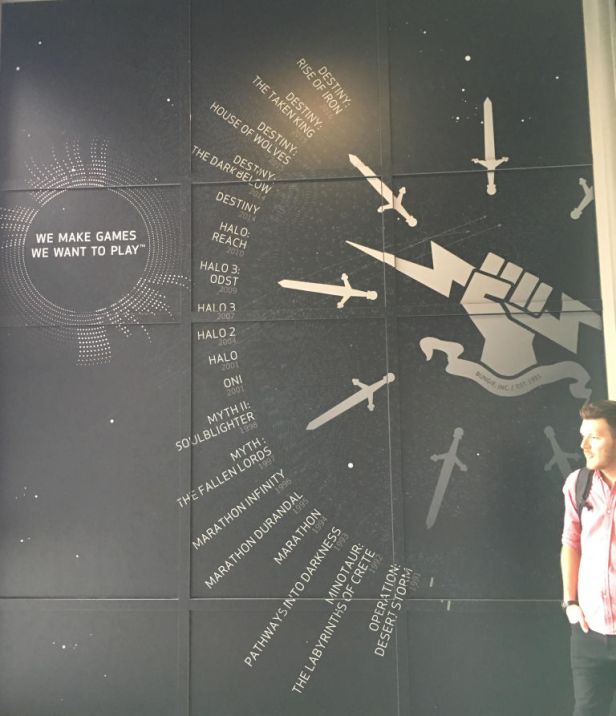
A 15 foot-high mural outside the otherwise understated entrance to Bungie’s headquarters in the well-heeled Seattle suburb of Bellevue lists the title of all 19 games the celebrated studio has made, starting with 1991’s Operation: Desert Storm and ending – for now – with the imminent Destiny expansion Rise of Iron.
On the other side of the door, the elongated foyer that greets visitors is decorated with mementoes and marketing materials associated all of them, ranging from a life-sized statue of Master Chief to scale models of Scarab Tanks. This is a company that’s proud of its past – and rightly so. Their motto is ‘We make games we want to play’.
The glass-fronted cabinet dedicated to Destiny is filled with all manner of objects of desire from Ghost replicas to Taken Captain statuettes and even a limited edition branded PS4. Included in the display is a T-shirt bearing the legend ‘That wizard came from the moon’ – the infamous line uttered by Peter Dinklage in the original version of the game that came to be symbolise its narrative shortcomings following a troubled launch back in 2014. Clearly this is a company not too proud to acknowledge their mistakes either.
To understand Destiny’s present – and future – you first need to know its past. The Destiny in Rise of Iron is almost unrecognisable from the one that stumbled into life two years ago. Amid reports of a last minute reboot a year out from launch that saw lead writer Joe Staten leave the project, swiftly followed by much of his story, the game felt disjointed and incoherent.
Players expecting an open world, massively multiplayer combination of World of Warcraft, Halo and Mass Effect were disappointed to find a repetitive experience bedevilled by an obtuse loot system and limited, repetitive content. Bungie’s attempt at birthing an entirely new genre – the massively multiplayer shared world first person shooter – had instead given rise to something more resembling Frankenstein’s monster.
“You have to imagine we came from Halo to this thing here,” recalls Shiek Wang, Art Director on Rise of Iron and also Lead Character Artist on the original Destiny. “And we took a long time to come to grips with what the game was. And it wasn’t until we had a build where we actually got to experience it that we realised what this game truly is.
“But nobody else saw that, right? So for the first six months people were constantly comparing our game to other game – ‘It’s kind of like Halo and WoW and Diablo mixed together’ kind of thing. And now we’re finally at this sweet spot where people recognise and respect the game for what it is. People don’t say it’s this and that anymore, they say it’s Destiny because they understand it now.
“But it’s a really hard road. For the longest time, even us developers, we didn’t know what it was. I’d even say for the first year or so, we kept updating it and changing it because we were trying to find out exactly what it was. But I’m extremely happy with where we are at right now.”
That cycle of updates and changes included two chunks of paid-for DLC – The House of Wolves and The Dark Below – that patched in some of the missing story, added endgame Raids and tweaked some of the misfiring mechanics such as loot distribution and character progression, but still faced charges of under delivering on content and value for money. Scott Taylor, who worked on both and is now Executive Producer of Rise of Iron, has a much rosier view of Year One.
“It was good!” he insists. “From our perspective we were always working on something, right? We were figuring out what we wanted to do but also what were we learning from releasing the game. And you see right away in Dark Below an attempt to tell the story using one character. We introduced [NPC character] Eris [Morn] in Dark Below. that whole experience kind of filters through her, and it’s her story. That’s the first time you kind of see us doing that.
“The new quest system started in House of Wolves and then got way expanded in [Destiny’s first expansion proper] The Taken King. So the first year was really a lot of growth and excitement. The game was coming out, we were trying to evolve the experience. For us it’s been amazing that we’ve been able to not just ship a game and [clicks fingers] it’s done. “
This iterative, evolutionary approach meant that Destiny did all of its growing up in public – something Scott Taylor insists, to my evident surprise, was actually good for the game.
“I think it’s amazing!” he laughs. “It feels like this type of game could only grow that way. I don’t know how you just hit something like this perfectly. It’s going to be evolving. To me that’s amazing. I’m choosing to look at it like, what can we do to make this better? To continue to make it better all the time – that’s the challenge that we have, and so I look at that as a huge positive for Destiny.”
And yet for all its faults – and there were many – Destiny still proved to be a hugely popular experience. Hundreds of thousands of players persevered with the half-finished story and half-baked loot system, eventually slipping into its intoxicating rhythm of daly and weekly strikes. It helped that Bungie absolutely nailed the shooting part of the game, expanding on that series’ design philosophy of regular bears of ’30 seconds of fun’ to create a combat experience that was endlessly exhilarating.
“Destiny shines in its moment to moment gunplay and it’s world building,” agrees Scott. “While you say the story was less than desirable, the opportunities we created with Destiny at launch were ones that are paying off now. There’s a bunch of things from The Taken King on where we heard about Crota and Oryx and then we started meeting them; we saw Saladin having a ritual about fallen Iron Lords that is enriching. And the experience of seeing them [in Rise of Iron] is the dividends we’re getting from creating a universe that we could then tell stories about.”
Destiny’s Year One experience for me was typified by the infamous Loot Cave, the popular name for a glitched monster closet in the Old Russia zone that allowed players to farm loot drops by shooting a constant stream of re-spawning mobs. It was completely mindless and yet utterly compelling, and its existence spread organically throughout the community until Bungie inevitably patched it out of the game.
“I did that!” exclaims Scott when I tell him I spent hours chatting to friends while shooting into that cave. “I did that! There was something compelling about that. I remember saying, yes we have to take this out, but I was doing it! There was something about having this kind of – it almost felt like a happening, like a club that opened or something. Things like that are very interesting.”
It speaks volumes about the different perspectives of players and developers that when I ask Scott at which point he felt like he was no longer fixing problems and instead started to forge his own path with the game – expecting an answer of around the time of The Taken King expansion – he instead looks at me with a slightly bemused expression.
“It’s so funny because I have a hard time even thinking about it like that.”
Really?
“Yeah!”
2015’s The Taken King set is widely regarded as the point where Destiny turned around. The meaty expansion introduced a deluge of new story content set in a genuinely captivating new area: The Dreadnought, the titular bad guy’s gargantuan maze-like space ship orbiting Saturn. More importantly, it fixed a lot of the systems that had previously hobbled the game, introduced proper quest management and overhauled the levelling mechanic by adding the gear-based Light.
Scott, however, is having none of it. “That’s so interesting,” he says, humouring me. “You say that but the way I think about it is, when we were walking on House of Wolves, it was like, how do we take all the information we have – both internally and externally – and make something amazing? I guess that’s just a different mindset. Maybe that’s just me, right? I’m focused on, like, ‘Hey, let’s make something great!’”
It transpires that Shiek shares a similar perspective. “What a lot of people don’t report on is that we love updating the game,” he tells me.
“We love hearing from the community what works and what doesn’t work and reacting to it. Being this close to the community makes us excited because we’re making changes that people can actually feel. And that’s super-exciting for us because for the longest time the games we made were made over a two or three year span and we don’t talk to people for a long time. For the first time we actually have a game that we’re constantly having a back and forth with the people that play our game.”
Now that Destiny is in a good enough place that Rise of Iron can concentrate on content rather than patching mechanics, the focus will inevitably shift back to the series’ story. Scott assures me that while the Iron Lords have been around since the very beginning – aka Destiny’s pre-launch beta in the form of the Iron Banner PvP tournament named in their honour – everything in Rise of Iron has been created bespoke.
“It’s kind of like thinking of a television show in some ways,” he explains. “You have the fiction for what Saladin is, and you know he has to do with honouring his Iron Lords, and we had ideas about SIVA a while ago as well.
“But then when we started actually working on this, and we decided we wanted to tell this particular story, we dove very deep on it. Was it there three years ago as a presented thing? No, not at all. We were looking at what was working and what areas of the game we wanted to focus on, and that’s when we took something that was deep fiction to help inform what we built.
“The other thing that dictated what this content was looking at The Taken King and House of Wolves and trying to do something that inhabited that same world but wasn’t exactly the same. The Dreadnought was an amazing, confined, maze-like space and the theme of that release was about the Taken King and how he was super evil. In [Rise of Iron] we’re shining a light on Saladin so there’s vast open spaces and armour and knights. We’re trying to inhabit that same universe and make it feel more full, but we aren’t trying to make the exact same thing.”
“My biggest challenge was finding a good way to get the story told through the art,” add Shiek. “We didn’t do a very good job obviously with previous Destiny of telling a story really well, and we really wanted to this time around to have the story be told to you but then wrapped back into the world.
“For example when you go the mausoleum [in the Iron Temple social space] for the first time and you see the tree and the two wolves there, that’s where the Iron Banner logo comes from. There’s lots of small things like Saladin carrying Jolder’s weapon for the first time – that pays homage to the opening cinematic of him trying to reach her at the end and how much he respects her. Even with the gear that they wear, we wanted to make sure it reflects the world really well and reflects the actual story of Rise of Iron.”
The big purple servitor in the room at this point is Destiny 2. Reports claim that the game’s full-blown sequel was due to release this year but, wary of the events of two years ago, Bungie asked publishers Activision if they could delay. The story goes they were granted more time but only on the condition they pushed something out this year in its place. And so Rise of Iron was born.
Suggestions to that effect are met with rolled eyes and raised eyebrows, but it’s impossible to play through the new Rise of Iron content without thinking about this context and wondering what ideas have sealed in from the other title or which new concepts are being focus tested in advance.
Take the much expanded and more detailed social space The Iron Temple, for example. Here the waters are muddied somewhat by the fact that as the first Destiny release freed from the shackles of Xbox 360 and PS3 support everything in the game now feels bigger and better. But certainly the way in which you have to defend it from the Fallen in opening mission King of the Mountain before being granted access feels like a step change in the relationship between players and the game’s environments.
“Similar to what I was saying before, whatever we do in the future will take a look at what Rise of Iron does and learn from it and use that as the evolution of Destiny for whatever comes next,” says Scott when pressed. “I mean, Rise of Iron is the best version we know how to make today and then tomorrow we’ll know a little more and we’re going to keep going. We were trying to make Rise of Iron and so I’m thinking about that, and that’s the latest version of Destiny. And then other things that other people are working on? They’re going to do what they want to do…”
I give it one last try. Given how Bungie are constantly evolving Destiny on the fly, how would you even go about crafting a standalone sequel? How and when do you draw a line under it and embark on something new?
“Well I don’t know,” answers Scott with a mischievous smile. “I guess we’ll find out…”
Indeed – but we might have to wait until Bungie have added another game title to that mural first.
A version of this feature was originally published by Digital Spy on September 14, 2016
 Dan Silver